Financial Life Planning · Tax Planning
How much can you afford to give your children?

By Robert Wilcocks, Founder, Quantum Life
CISI Level 6 Advanced Financial Planning · Registered Life Planner®
Published · Updated
In short
You can afford to give your children whatever is left once you have worked out what you need to keep for the rest of your life, including care costs, inflation and living longer than expected. Settle that number first, then give with confidence, using the Inheritance Tax gifting rules as a benefit rather than the reason.
Retirement used to be the point when you started spending the money you had accumulated.
Increasingly, some of it is being spent on everybody else.
New research from Quilter found that UK retirees are giving an average of £4,522 a year to their families, including direct financial support and help with education costs.
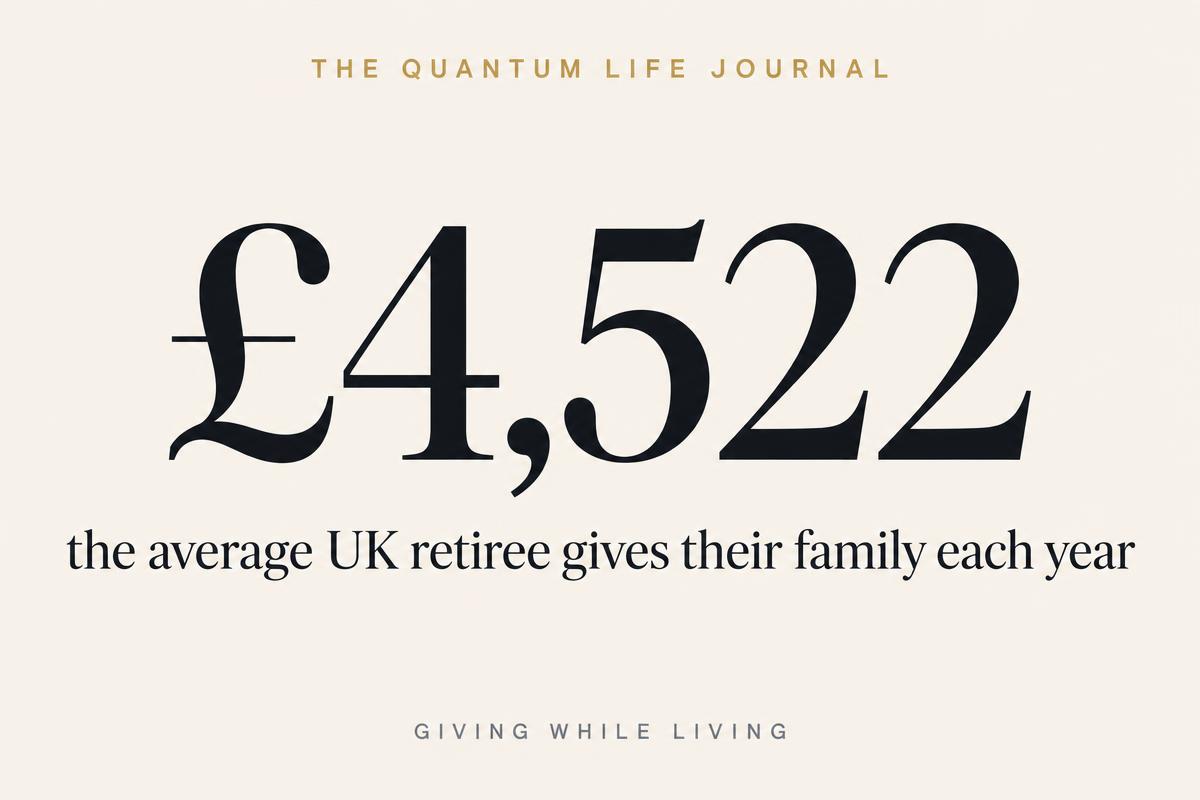
That is more than twice the £2,110 they spend on food.
For wealthier families, the sums can obviously be much larger.
A deposit for a first home. School fees for the grandchildren. Help starting a business. Money after a divorce. Perhaps simply making life a little easier at a time when your children have mortgages, young families and enormous outgoings.
There is something rather appealing about giving money when you are around to see what it does.
£100,000 at 35 might fundamentally change your child’s life. The same £100,000 inherited at 65 may make considerably less difference.
1.The difficult part is knowing how much you can safely give away
The research found that while 69% of retirees were satisfied with their current retirement income, 60% were worried about maintaining their standard of living in future.
Both things can be true.
You can feel wealthy today and still have another 20 or 30 years of spending ahead of you. Care costs, inflation, investment returns and simply living longer than expected can all change the picture.
So before making a substantial gift, I’d want to understand what happens afterwards.
Can you still live the way you want?
What if markets fall?
What if you need more care later?
What if you want to move house, travel more or help another child in five years’ time?
2.Tax matters too — but it shouldn’t be the only reason for giving
Under current Inheritance Tax rules, individuals have a £3,000 annual gifting exemption, with one year’s unused exemption capable of being carried forward. Larger outright gifts can generally fall outside the estate if you survive for seven years, subject to the detailed rules and other exemptions.
For larger gifts, proper tax and legal advice matters, particularly where trusts, property or other assets are involved.
But the more interesting calculation is often personal rather than tax-driven.
Work out what you need to keep first.
Then you know what you can give away without spending the next decade quietly worrying that you were too generous.
Leaving money to your family can change their inheritance. Giving some of it at the right moment can change their life.
Rob
Frequently asked questions
How much do UK retirees give their families each year?
Research from Quilter found UK retirees give an average of £4,522 a year to their families, including direct financial support and help with education costs. That is more than twice the £2,110 they spend on food.
How much can I give away each year free of Inheritance Tax?
Under current rules, each individual has a £3,000 annual gifting exemption, and one year's unused exemption can be carried forward. Larger outright gifts can generally fall outside your estate if you survive seven years, subject to the detailed rules and other exemptions.
What should I check before making a large gift to my children?
Check that you can still live the way you want afterwards, including if markets fall, you need care later, or you want to move, travel or help another child. For larger gifts, particularly involving trusts or property, take proper tax and legal advice.