Financial Life Planning
The Three Mountains.
Building wealth. Protecting wealth. Using wealth well.
By Robert Wilcocks, Founder, Quantum Life
CISI Level 6 Advanced Financial Planning · Registered Life Planner®
Published · Updated
In short
The three mountains of financial life are building wealth with a plan for what it is for, spending it with confidence and without regret, and passing on both the capital and the character to the next generation. Wherever you are on the range, the work is the same: aligning your capital with your values.
Key takeaway
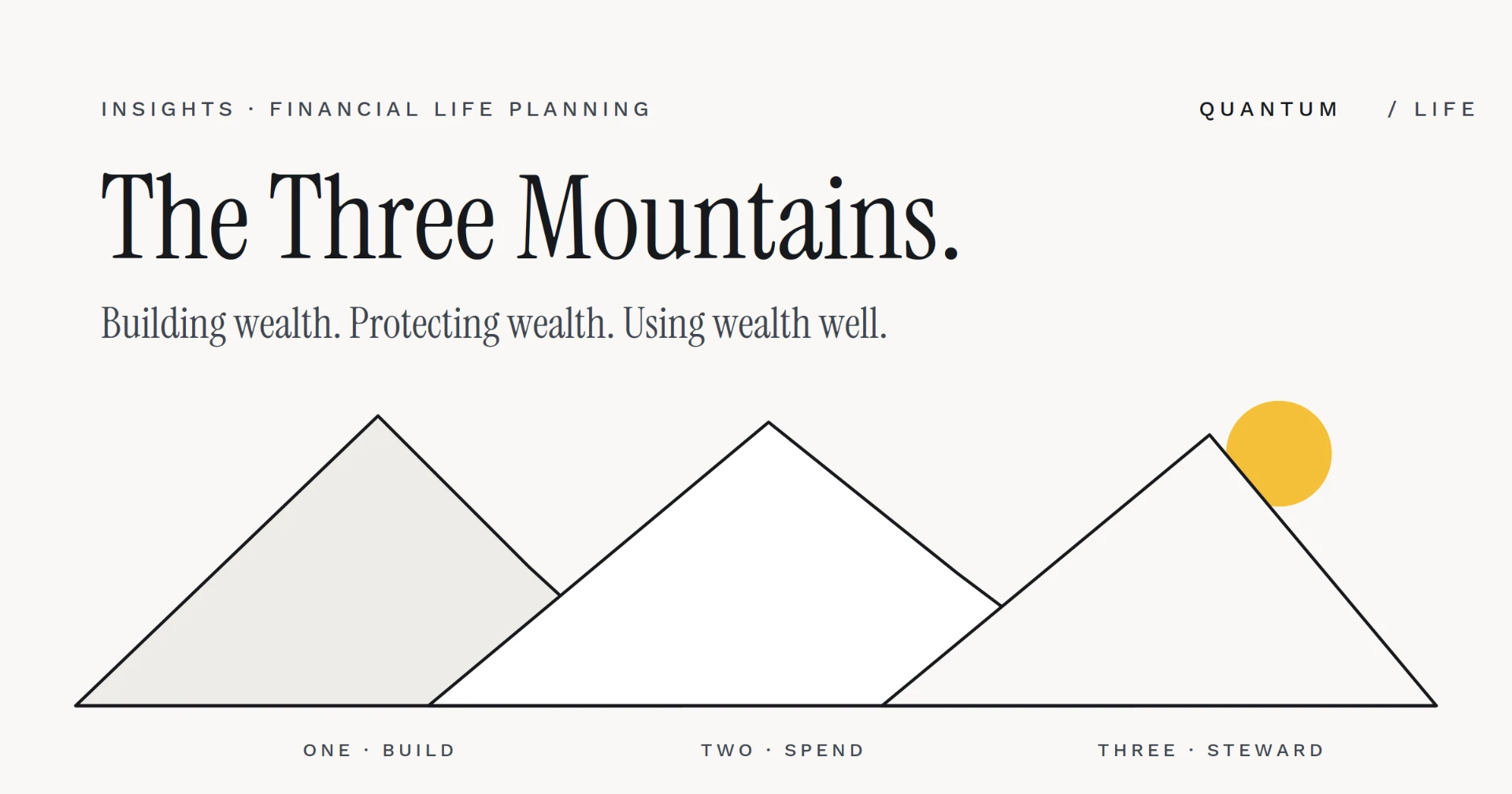
The mountains describe what wealth does. True Wealth is freedom.
A few years ago I read a book by David Brooks called The Second Mountain. His idea stuck with me. The first mountain is the one society tells us to climb — career, success, status, building your identity. Some people summit it, look around, and feel strangely empty. The ones who flourish, Brooks argues, find a second mountain: one about purpose, commitment, and giving yourself away to something bigger than you.
I've spent twenty years helping people with money, and I kept thinking: that's exactly what I watch happen with wealth. So I've borrowed his idea, adapted it, and added one — because in financial life, I think there are three mountains.
Here's the map.
Mountain One: Financial Freedom
Let's be honest about this mountain first: most people on Earth never get near the summit. Billions still live in poverty. If you're reading this, you're probably in the top few per cent of the luckiest humans who have ever existed — partly the lottery of where you were born, and partly, yes, your skill, effort and graft. Both things are true. Congratulations, genuinely.
Here's what the summit actually feels like, though. I'll never forget one client telling me about the day he made his first million. He'd pictured that moment for years. And when it arrived, his honest reaction was: “Oh. Is that it?”
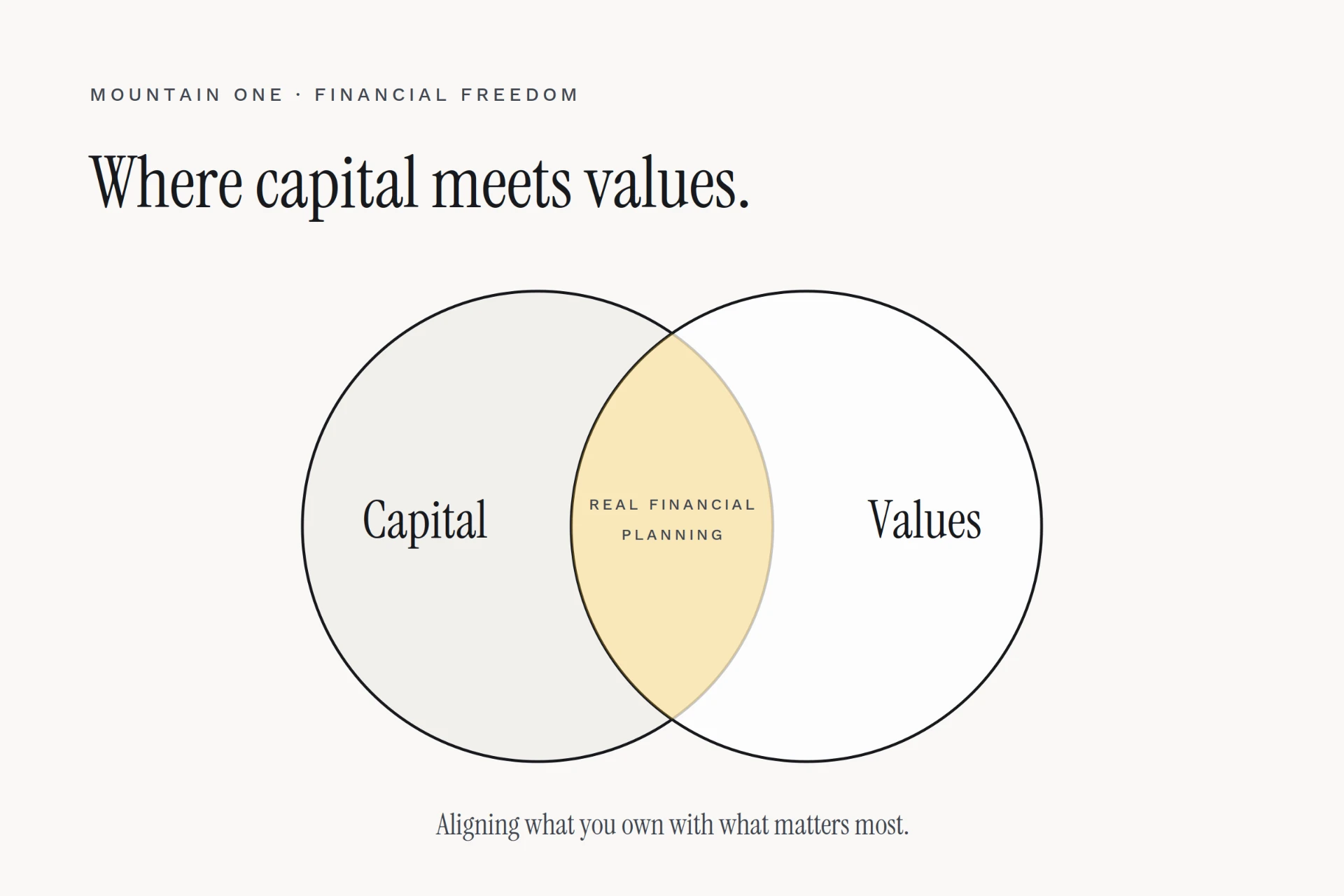
He's gone on to far greater success since — but the real work we've done together wasn't chasing the next million. It was aligning his capital with his values: not just purposeful spending, but purposeful investing.
That's the lesson of Mountain One. Climbing it is hard — but like Everest, the summit isn't the dangerous part. More climbers die on the descent than on the way up. In money terms: you need a plan for what the wealth is for before you have it. Otherwise you reach the top, the view is thinner than advertised, and the way down is where things go wrong.
Mountain Two: Purposeful Spending
If Mountain One is financial freedom, Mountain Two is what you do with it. I sometimes call this the Third Act of your life: childhood was Act One, working life Act Two — and now comes the act with the strange name, "retirement." I've never liked that word. It describes leaving something, when the whole point is arriving somewhere. You should retire to something, not from something — and the more you think of this phase as designing your Third Act, rather than retiring from your second, the better it tends to go.
Getting up Mountain One runs on four almost embarrassingly simple rules — Morgan Housel's The Psychology of Money makes the case better than anyone: spend less than you earn, invest the difference, repeat, and give it time. Housel's deeper point is that building wealth has little to do with income or investment genius and everything to do with savings rate and patience. Wealth, as he puts it, is what you don't see.
And here's the cruel joke of Mountain Two: the skills that got you up the first mountain are the exact opposite of what gets you up the second.
A lifetime of diligent saving — and then the income tap turns off. The C-suite salary, the drawings from the business: for most people, that tap eventually stops. It might wind down gently for a while — a bit of consulting, a board seat or two — but ultimately it stops. And now you're drawing down the very capital you spent decades protecting.
Stranger still, your financial planner may be actively encouraging you to spend more than you earn. On purpose.
Almost every client finds this genuinely hard. Watching your portfolio fall because you're actually using it triggers every alarm you've spent a lifetime installing.
And if you're a family office principal, the maths may not even be the problem. The dividends from the businesses and operations may comfortably cover what you spend — a fantastic position to be in. But Mountain Two has a second psychological shift waiting, and it tends to catch the wealthiest hardest: identity.
On Mountain One you were the CEO. The go-to person. The one the media rang for a quote. That's gone now — and it's been replaced by a Tuesday afternoon, a weekend of golf already played, and a quieter, harder question: what am I actually for today?
For families with one to ten million, the fear on this mountain is running out of money. For principals, the fear is running out of purpose. A good plan has to answer both.
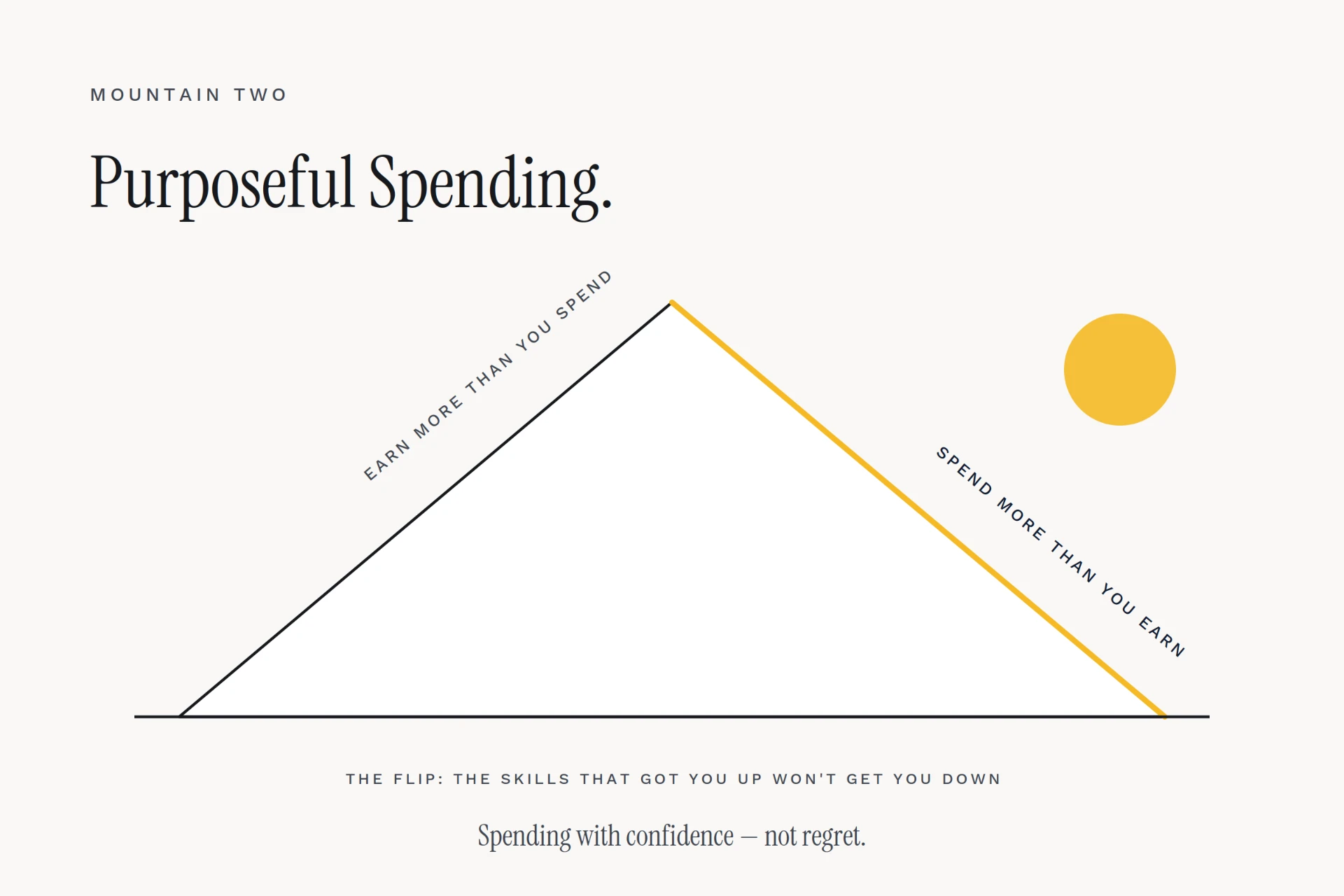
This is where real planning earns its keep — not because the plan will be precisely right (it won't be; no plan survives contact with reality), but because the process of planning, built on sensible assumptions about growth, tax and inflation, gives you something rarer than accuracy: confidence. The clarity to spend without fear.
Because here's what's worse than running out of money on Mountain Two: coming down it, near the end, and realising you could have spent more — on the people, the experiences, the adventures — but you were too busy worrying.
That's the big word beginning with R. Regret.
And we get one life on this rock, spinning around a nuclear star at unreasonable speed. What was it all for, if not to be able to say — as Mr Sinatra sang — I did it my way?
Mountain Three: Mount Steward
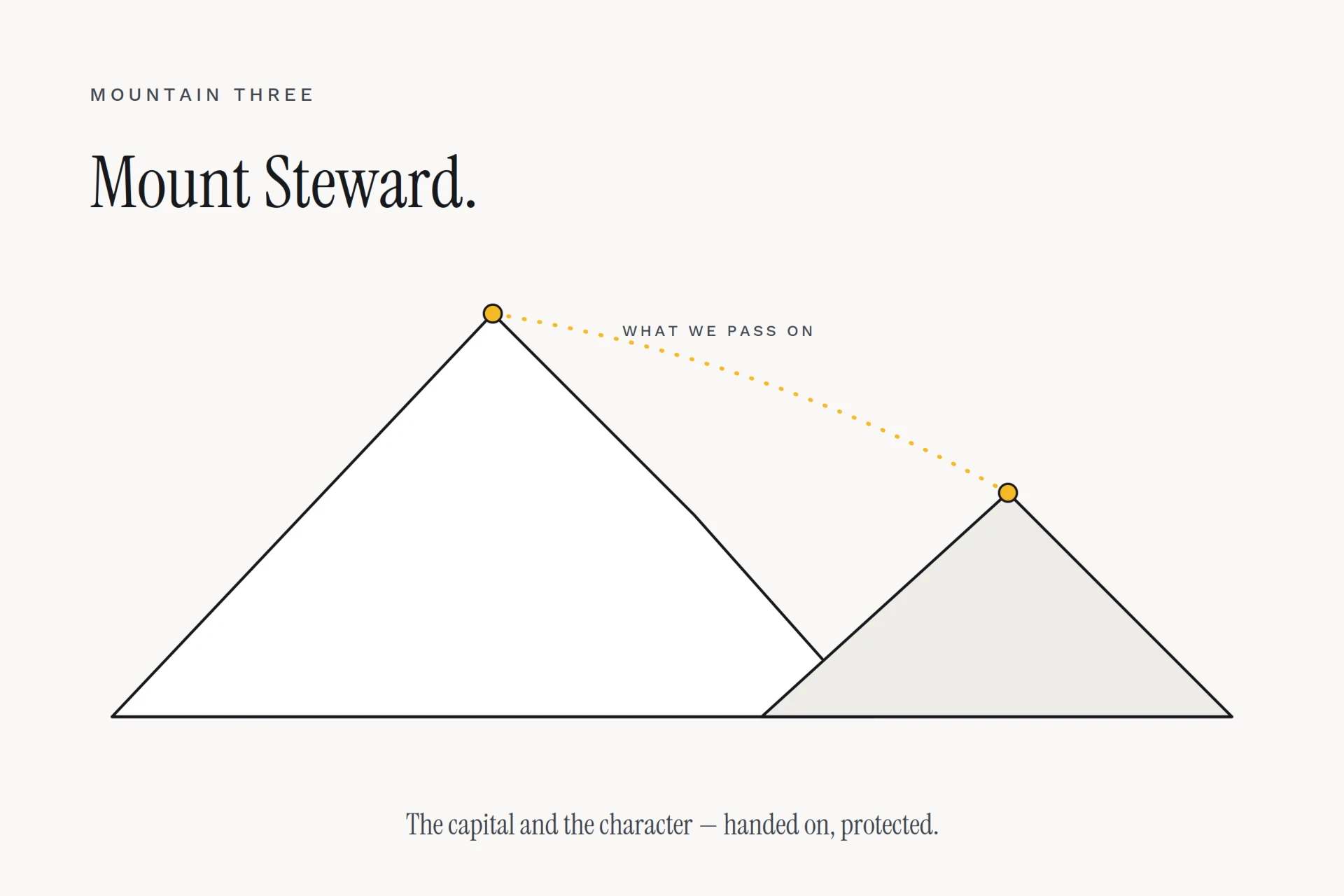
For most families, two mountains is a full and brilliant life. But there is a third, and it's the one I find most meaningful: Mount Steward.
This mountain is about what we pass on — and only some of it is money. The rest is human capital: our stories, our experiences, the mental models, the tools. How to build or scale a business. How to communicate properly. How to have agency. How not to worry so much. All the things we muddled through and learned the hard way, handed on so the next generation doesn't start from zero.
The financial side of stewardship isn't just minimising inheritance tax, wherever in the world it finds you. It's structure as protection: so that if someone divorces, they're protected. If a business fails and bankruptcy comes knocking, they're protected. If someone falls in with the wrong crowd, or falls for a scam — protected.
And crucially, the next generation isn't just named in the documents; they're included in the planning, so the values and habits travel with the money.
Because the greatest gift you can leave isn't a sum. It's the ability to climb Mountain One themselves.
The map, in one line each
Mountain One: build the wealth — with a plan for what it's for.
Mountain Two: spend it with confidence and without regret.
Mountain Three: pass on everything that matters — the capital and the character.
You'll recognise these as the three kinds of families we serve: Builders, Spenders, Stewards.
Wherever you are on the range, the work is the same at every altitude — aligning your capital with your values.
That, in the end, is what we mean by Real Wealth.
Frequently asked questions
What are the three mountains of financial life?
Mountain One is financial freedom: building the wealth. Mountain Two is purposeful spending: using it with confidence in your Third Act. Mountain Three, Mount Steward, is passing on what matters, both money and human capital.
Why is spending in retirement so hard?
The skills that build wealth, spending less than you earn, are the opposite of those needed to use it, which can mean spending more than you earn on purpose. Watching a portfolio fall because you are using it goes against a lifetime of habits, which is why a plan that gives confidence matters.
What does stewardship of family wealth involve?
More than minimising Inheritance Tax. It includes structures that protect the next generation through divorce, business failure or scams, and involving them in the planning so the values and habits travel with the money.